Case study · Cremagencia for Las Lomas · Expocruz 2026
Caso · Cremagencia para Las Lomas · Expocruz 2026
La Torre de Todos
One stand, ten nights, an 1889 portrait on screen in about 20 seconds. 870 visitor portraits, none lost to a system failure. How it was built, what broke, and what we changed.
Un stand, diez noches, un retrato de 1889 en pantalla en unos 20 segundos. 870 retratos de visitantes, ninguno perdido por una falla del sistema. Cómo se hizo, qué se rompió y qué cambiamos.
870visitor portraits in ten nights
1,465faces in those portraits
407group portraits, 2 to 4 people
21 sphoto to TV, median
32 sphoto to a working link on the phone, median
0portraits lost to system failures
870retratos de visitantes en diez noches
1.465caras en esos retratos
407retratos de grupo, de 2 a 4 personas
21 sde la foto a la TV, mediana
32 sde la foto al link en el celular, mediana
0retratos perdidos por fallas del sistema
The brief
Every visitor, an ironworker of 1889
Las Lomas, a Bolivian steelmaker, brought a stand themed on the Eiffel Tower to Expocruz 2026; the theme came from their brief. We proposed that every visitor see themselves as an 1889 ironworker building the tower, and that all the portraits together form the tower in an online mural. It ran from 18 to 27 September, 20:00 to 23:00.
What a visitor saw
A photo, a countdown, and 1889 on the screen
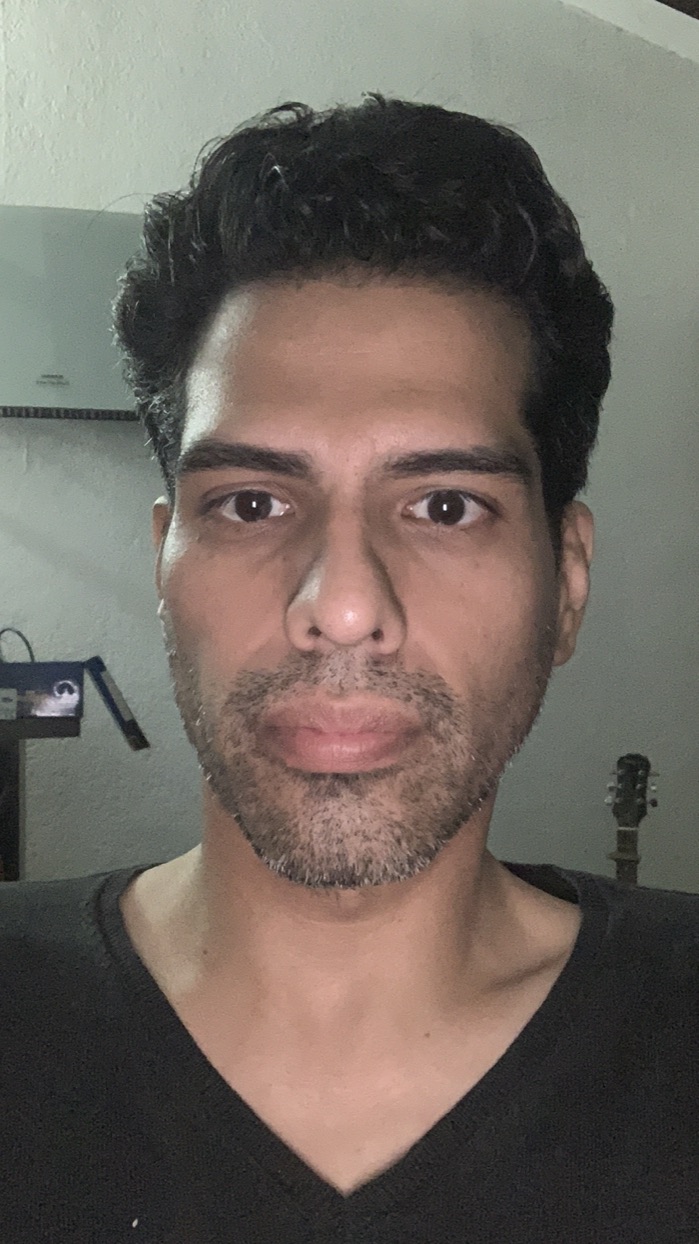
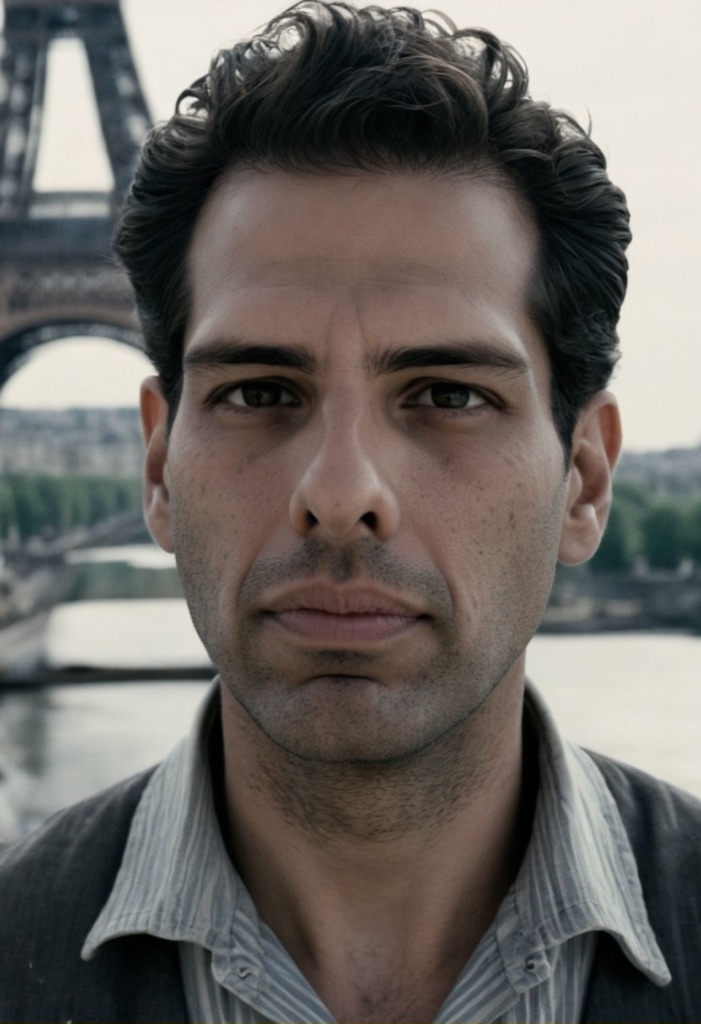
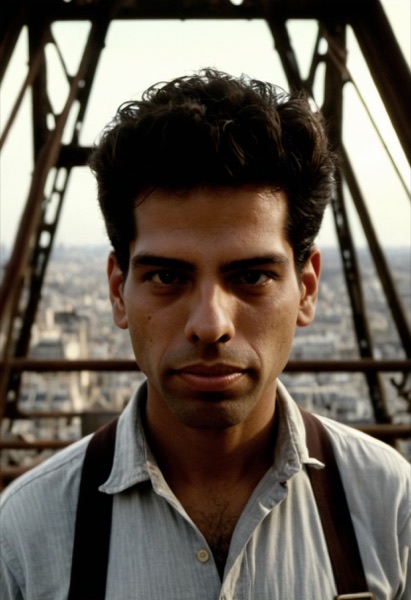
This is the stand as it ran from the 23rd. The visitor stands on a mark on the floor. Countdown, photo. While the portrait is being made, a line of text warns that it won't be identical: it is a version of them as they would have looked in 1889, in Paris, forging the tower. About 20 seconds later the portrait is on the TV, large, with a code and a QR. At about 32 seconds the link works on their phone. Up to four people fit in one portrait. The operator uses two buttons on a remote.
The photoThe portrait
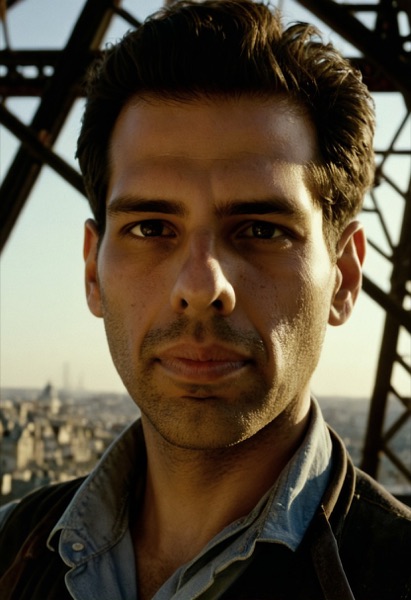
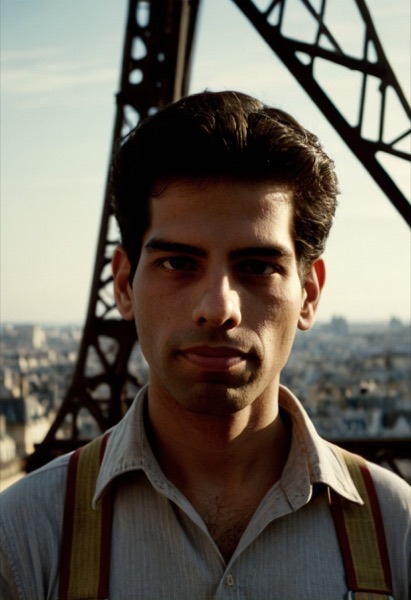
The only face on this page belongs to the person who built the Torre: Ernesto Anaya, in team tests. Visitor portraits were made for the online mural, not for advertising, so none are shown here.
The system
Rent by the hour what isn't worth buying
A USB camera. A 2017 MacBook that receives the photo and finishes the portrait. A GPU server rented by the hour in Europe, which does the AI part. A page on dearborn-ventures.com for every portrait, online until 31 October 2026.
The plan was to buy a machine for the stand so nothing depended on the internet. On 17 September, the day before opening, we decided not to buy it. Each visitor uses under 2 MB, so the stand's satellite connection was enough to rent a more powerful server by the hour. When the fair closed there was no hardware left to sell.
The trade-off: no internet, no new portraits. So the decision that mattered most was this one: every photo is saved on the Mac first, and if the server does not answer, it waits in a queue and goes through on its own when the connection returns.
Portraits per night. On the first night the server was not available until 22:26.
870 visitor portraits in ten nights. 407 were group portraits of 2 to 4 people.
1,465 faces in those portraits. Someone photographed twice counts twice.
0 portraits lost to system failures.
Photo to TV: 21 seconds, median.
Photo to a working link on the phone: 32 seconds, median.
After the fix on Thursday 24, no photo taken between 20:00 and 23:00 took more than a minute to reach the phone.
Where the limit is. With a line, 66 seconds pass between one photo and the next. The server works for about 20 of them; the rest is countdown, portrait on screen and the next visitor stepping in. The server was busy 16% of the time on average, 44% in the busiest hour. At that pace the stand makes 55 to 60 portraits an hour; the best hour had 58. Serving more people means shortening the cycle at the stand, not renting a bigger server.
Four failures that changed the design
A chain of parts with no spares
From the 18th to the 21st, a different link broke almost every night.
18 and 20 September
The server that vanished
On the first afternoon the rented server disappeared, and that night produced almost no portraits. On Sunday the 20th it happened again, through our own mistake: the prepaid balance ran out and the provider shut the server down.
→ The balance is checked before every night. From the 20th, one server ran without replacement to the end.
Monday 21
The full disk
We launched group portraits that same afternoon, on a busy night. The server's disk filled up, and from 22:25 the internet was down. 29 portraits arrived between 1 and 3.6 hours late. None was lost.
→ From the 23rd, an automatic watchdog checks everything every five minutes and keeps the disk clean.
Wednesday 23
The screen that froze
The TV froze for a few seconds during every portrait. The program on the Mac waited for the server and answered nothing else meanwhile.
→ The heavy work now runs separately. On a test copy, during a portrait, the Mac went from taking 22 seconds to answer to taking 5 milliseconds.
Friday 25 and Sunday 27
The cut at closing
The internet went off at closing time with photos still queued. The queue held every one, and they went out on their own when the connection returned, the last one 1 hour 45 minutes later.
→ New step in the closing guide: the night isn't over until the last portrait is on the TV.
What prevented losses was a design decision: the queue. Without it, the photos taken during the outages on the 21st, 25th and 27th would have been lost.
What we would do differently
Three changes for the next event
Measure whether people kept their portrait
We know how many portraits went out, not how many were opened or shared.
Treat the internet and the computer as critical parts
The connection caused the longest waits and was never measured; the Mac restarted at 20:13 on the last Sunday, with the stand open. Next time: a measured connection, a newer computer, a UPS.
More time, bigger type
The QR stays 20 seconds, in small type; many older visitors struggle to scan it in time. What worked best: someone at the stand photographing the screen with the visitor's phone.
The same discipline, at a live event
Built by Cremagencia, the agency arm of Dearborn
Dearborn runs as one system: a building administration platform, a laundry vertical under construction on the same rails, and an agency that brings in cash for the rest. The Torre was built by Cremagencia, the agency arm.
Same method as the rest: measure before changing anything, rent by the hour what isn't worth buying, own the code and the domain, and write each failure down where the next person will find it. The machine is meant to be set up at another event, with another brand and portrait style; it hasn't run outside this fair yet. In design, not built yet: a self-service kiosk with no Mac at the stand.
El encargo
Cada visitante, un obrero de 1889
Las Lomas, siderúrgica boliviana, llevó a Expocruz 2026 un stand sobre la Torre Eiffel; el tema venía de su brief. Le propusimos que cada visitante se viera como un obrero de 1889 construyendo la torre, y que todos los retratos juntos formaran la torre en un mural en línea. Funcionó del 18 al 27 de septiembre, de 20:00 a 23:00.
Lo que vio un visitante
Una foto, una cuenta regresiva y 1889 en la pantalla
Así quedó el stand desde el 23. El visitante se para sobre una marca en el piso. Cuenta regresiva, foto. Mientras se arma el retrato, un texto avisa que no va a ser idéntico: es una versión suya como se habría visto en 1889, en París, forjando la torre. Unos 20 segundos después el retrato aparece grande en la TV, con un código y un QR. Hacia los 32 segundos, el link ya funciona en su celular. Entran hasta cuatro personas en un retrato. Quien atiende usa dos botones de un control remoto.
La fotoEl retrato
La única cara en esta página es la de quien construyó la Torre: Ernesto Anaya, en pruebas del equipo. Los retratos de los visitantes se hicieron para el mural en línea, no para publicidad; por eso no se muestran acá.
El sistema
Alquilar por hora lo que no conviene comprar
Una cámara USB. Una MacBook de 2017 que recibe la foto y arma el retrato final. Un servidor con tarjeta gráfica, alquilado por hora en Europa, que hace la parte de inteligencia artificial. Una página en dearborn-ventures.com para cada retrato, en línea hasta el 31 de octubre de 2026.
El plan era comprar una máquina para el stand y no depender de internet. El 17 de septiembre, la víspera de abrir, decidimos no comprarla: cada visitante usa menos de 2 MB, y la conexión satelital del stand alcanzaba para alquilar un servidor más potente. Al cierre no quedó ningún equipo que vender.
La contracara: sin internet no salen retratos nuevos. Por eso la decisión que más pesó fue esta: cada foto se guarda primero en la Mac y, si el servidor no contesta, espera en una cola y sale sola cuando vuelve la conexión.
Lo que se midió
Contado de los registros de la propia Torre, dos veces
Retratos por noche. La primera noche el servidor no estuvo disponible hasta las 22:26.
870 retratos de visitantes en diez noches. 407 de grupo, de 2 a 4 personas.
1.465 caras en esos retratos. Quien se sacó dos fotos cuenta dos veces.
0 retratos perdidos por fallas del sistema.
De la foto a la TV: 21 segundos de mediana.
De la foto al link en el celular: 32 segundos de mediana.
Desde el arreglo del jueves 24, ninguna foto tomada entre las 20:00 y las 23:00 tardó más de un minuto en llegar al celular.
Dónde está el límite. Con fila, entre una foto y la siguiente pasan 66 segundos. El servidor trabaja unos 20; el resto es cuenta regresiva, retrato en pantalla y cambio de visitante. Estuvo ocupado el 16 % del tiempo; el 44 % en la hora más llena. A ese ritmo salen entre 55 y 60 retratos por hora; la mejor hora tuvo 58. Para atender a más gente hay que acortar el ciclo del stand, no alquilar un servidor más grande.
Cuatro fallas que cambiaron el diseño
Una cadena de piezas sin repuesto
Entre el 18 y el 21, casi cada noche se cortó un eslabón distinto.
18 y 20 de septiembre
El servidor que desapareció
La primera tarde el servidor alquilado desapareció y esa noche casi no hubo retratos. El domingo 20 pasó otra vez, por un error nuestro: se acabó el saldo prepago y el proveedor lo apagó.
→ El saldo se revisa antes de cada noche. Desde el 20, un solo servidor aguantó hasta el cierre.
Lunes 21
El disco lleno
Estrenamos los retratos de grupo esa misma tarde, en una noche de mucho público. Se llenó el disco del servidor y desde las 22:25 se cayó el internet. 29 retratos salieron entre 1 y 3,6 horas tarde. Ninguno se perdió.
→ Desde el 23, un vigilante automático revisa todo cada cinco minutos y mantiene limpio el disco.
Miércoles 23
La pantalla que se trababa
La TV se congelaba unos segundos en cada retrato: el programa de la Mac esperaba al servidor sin atender nada más.
→ El trabajo pesado pasó a correr aparte. En una copia de prueba, durante un retrato, la Mac pasó de tardar 22 segundos en contestar a tardar 5 milésimas de segundo.
Viernes 25 y domingo 27
El corte al cierre
El internet se cortó al cierre, con fotos en cola. La cola las guardó todas y salieron solas cuando volvió la conexión, la última 1 hora y 45 minutos después.
→ Paso nuevo en la guía de cierre: la noche no termina hasta que el último retrato sale en la TV.
Lo que evitó pérdidas fue una decisión de diseño: la cola. Sin ella, las fotos de los cortes del 21, el 25 y el 27 se habrían perdido.
Lo que haríamos distinto
Tres cambios para el próximo evento
Medir si se llevaron el retrato
Sabemos cuántos salieron, no cuántos se abrieron o compartieron.
Cuidar el internet y la computadora
El internet causó las esperas más largas y nunca se midió; la Mac se reinició a las 20:13 del último domingo, con el stand abierto. Próxima vez: conexión medida, una computadora más nueva y una UPS.
Más tiempo y letra más grande
El QR queda 20 segundos, en letra chica; a muchas personas mayores les cuesta escanearlo a tiempo. Lo que mejor funcionó: que alguien del stand le sacara foto a la pantalla con el celular de la persona.
La misma disciplina, en un evento en vivo
Lo hizo Cremagencia, el brazo de agencia de Dearborn
Dearborn funciona como un sistema: una plataforma de administración de edificios, una vertical de lavandería en construcción sobre los mismos rieles y una agencia que genera caja para el resto. La Torre la hizo Cremagencia, el brazo de agencia.
Se hizo igual que lo demás: medir antes de cambiar, alquilar por hora lo que no conviene comprar, ser dueños del código y del dominio, y dejar cada falla escrita donde el próximo la va a encontrar. La máquina está pensada para montarse en otro evento, con otra marca y otro estilo de retrato; todavía no se probó fuera de esta feria. En diseño, sin construir todavía: un tótem que funcione solo, sin Mac en el stand.